The Eden Institute Biblical Herbalism Education

Eden's Table · Sprouts, K-2

Start teaching this week.

The first 9 weeks of the 36-week Eden's Table Sprouts year. The Teacher's Guide, the Student Notebook and the Read-Aloud storybook for those weeks, as an instant download for $39. Sit down with it tonight and know whether this is the way your family wants to learn plants.

The 9-week starter

Weeks 1 to 9 of 36, with everything you need to teach them: forty-five daily lessons, the write-in Notebook pages and four storybook readings. Teach it tonight and decide about the rest of the year later.

Using an education savings account or scholarship? See how to buy in your state.
What you get

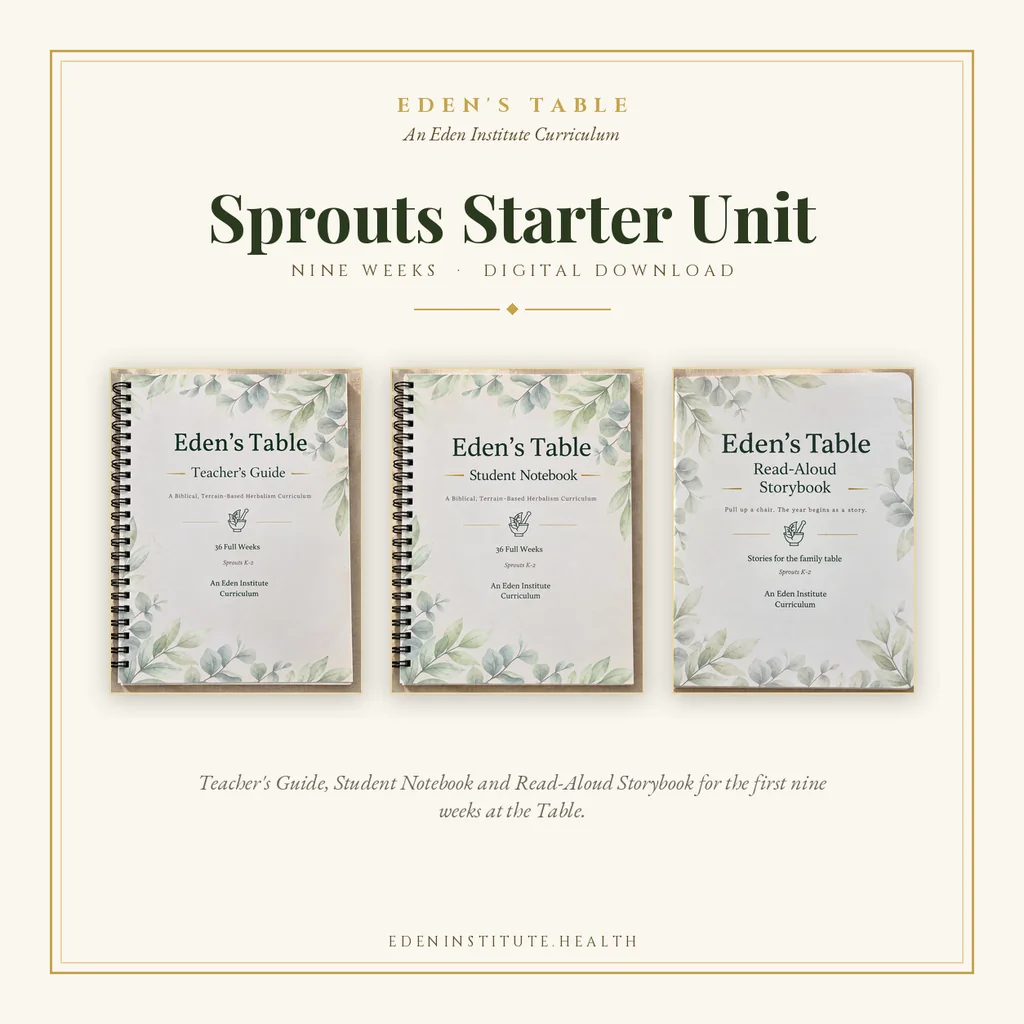
Sprouts Starter Unit: the Teacher's Guide, Student Notebook and Read-Aloud Storybook for the first nine weeks, as a digital download
  • ·Teacher's Guide, weeks 1 to 9. Forty-five daily lesson plans, scripted, with the Week at a Glance for each week.
  • ·Student Notebook, weeks 1 to 9. Her write-in pages: drawings, kitchen-lab observations, vocabulary, weekly review.
  • ·Read-Aloud Storybook. The four readings that fall in these nine weeks.
  • ·PDF, instant download. Print at home; letter size for the two books, small storybook page for the stories.
  • ·Yours to keep and reprint. Print it again for the next child, as often as you like.

9 weeks of the 36-week year

Weeks 1 to 9 of the 36-week Sprouts year, in order. Forty-five daily lessons, not excerpts. Weeks 10 to 36 are in the full year, the Printed Curriculum Set.

A unit finished, and the next one opened

Unit 1, In the Garden God Made, runs its full six weeks and closes. Then weeks 7 to 9 open Unit 2, When Your Body Talks, where the work turns from wonder at the design to reading the body's signals. You do not sample a unit. You finish one, and feel the year turn into the next.

The Teacher's Guide

Every daily lesson plan for those nine weeks, with the standards alignment, the botany behind each herb, and what to say when a five year old asks why.

The Student Notebook

The child's write-in pages: nine labelled botanical drawings, nine kitchen-lab observations, forty-five vocabulary words that never repeat, and a written review each week.

The Read-Aloud Storybook

The storybook has seven readings across the whole 36-week year, not one a week. Four of them fall inside these nine: the opening, Welcome to the Table, and then Life Force, Vovó's Lineage and Symptoms as Signals. The next one is not until week 18. A story reads aloud just as well from a screen, so it comes with your download.

Sprouts, kindergarten through second grade

Written for readers and pre-readers together, so an older sibling and a younger one can sit at the same table.

Component 1 · Read-Aloud Storybook

Every week begins with a story.

In the Starter Unit: weeks 1 to 9 of this, as a download.

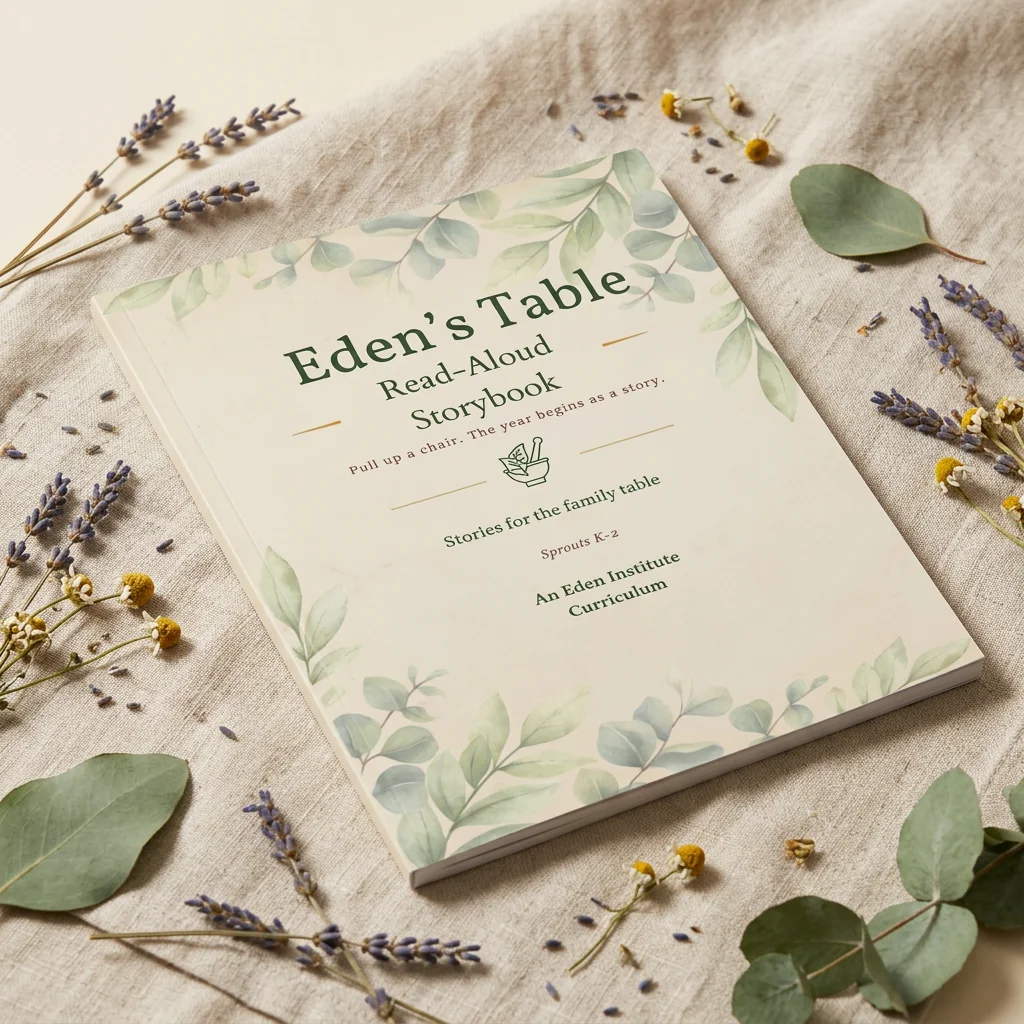
Eden's Table Read-Aloud Storybook, front cover, with the botanical leaf border
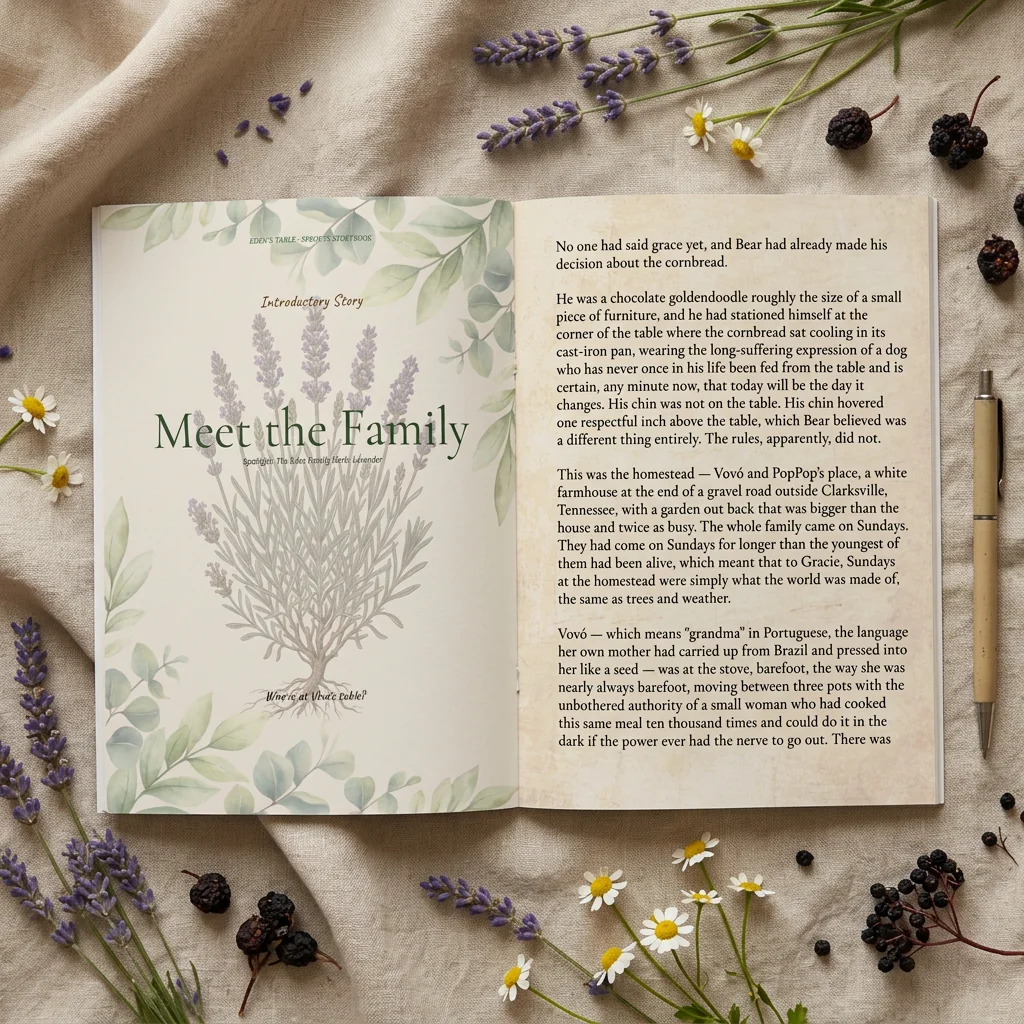
Read-Aloud Storybook open to a story spread

Inside the storybook

Sprouts K-2 and Seedlings 3-5

The same family, carried across both bands. A simple parable at K-2 becomes a story of real choices at 3-5.

Before there is a lesson about a plant, there is a family. Vovó in the garden. PopPop with his hands in the dirt. A scraped knee, a jar on a windowsill, a grandmother who knows which flower to reach for. The botany, the scripture, and the kitchen lab all hang on that narrative hook, which is why a child who cannot yet define a term can still tell you exactly why Vovó chose the plant she chose. This is the piece that makes the curriculum stick, and it is the piece most curricula skip. Facts taught cold are facts forgotten by Friday.

“It is the least academic-looking thing in the set, and it is doing the most important work in it.”

Component 2 · Teacher's Guide

You do not need to know herbalism to teach this.

In the Starter Unit: weeks 1 to 9 of this, as a download.

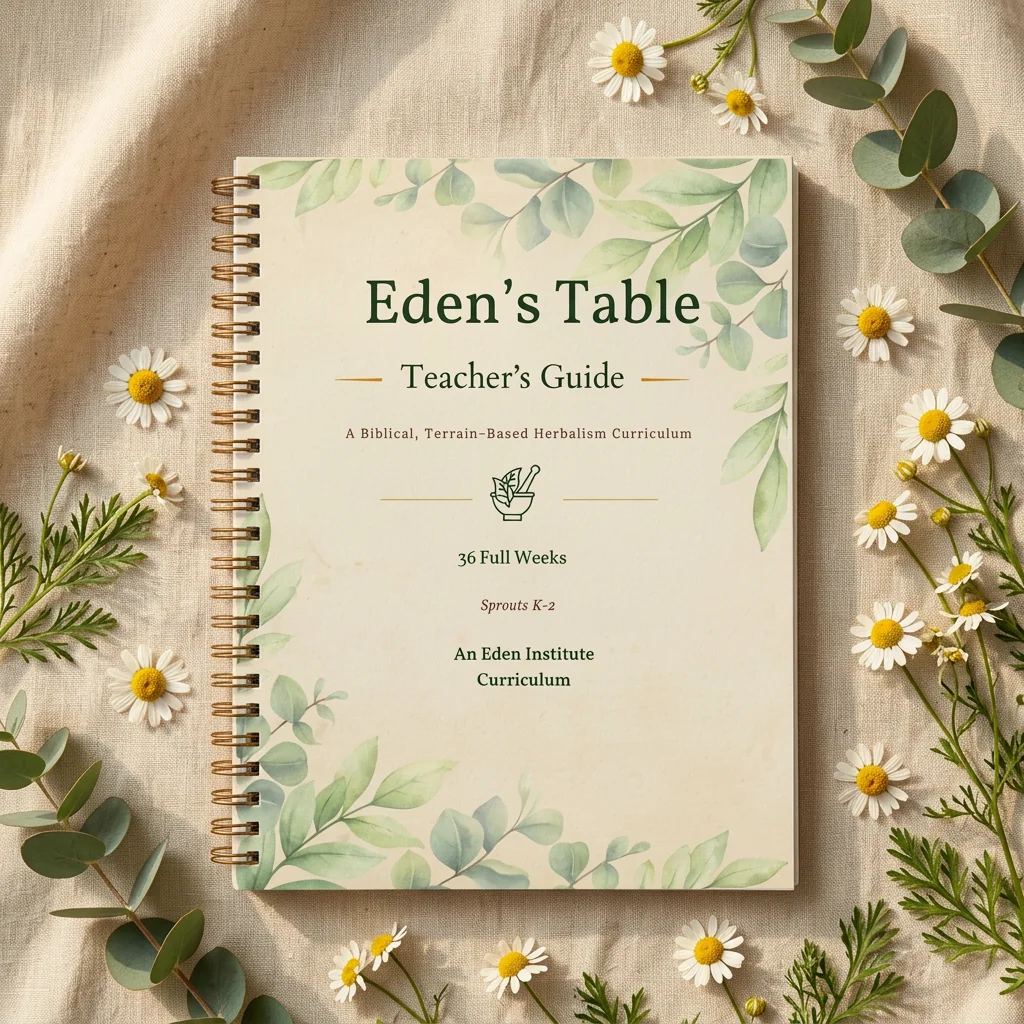
Eden's Table Teacher's Guide, coil-bound front cover
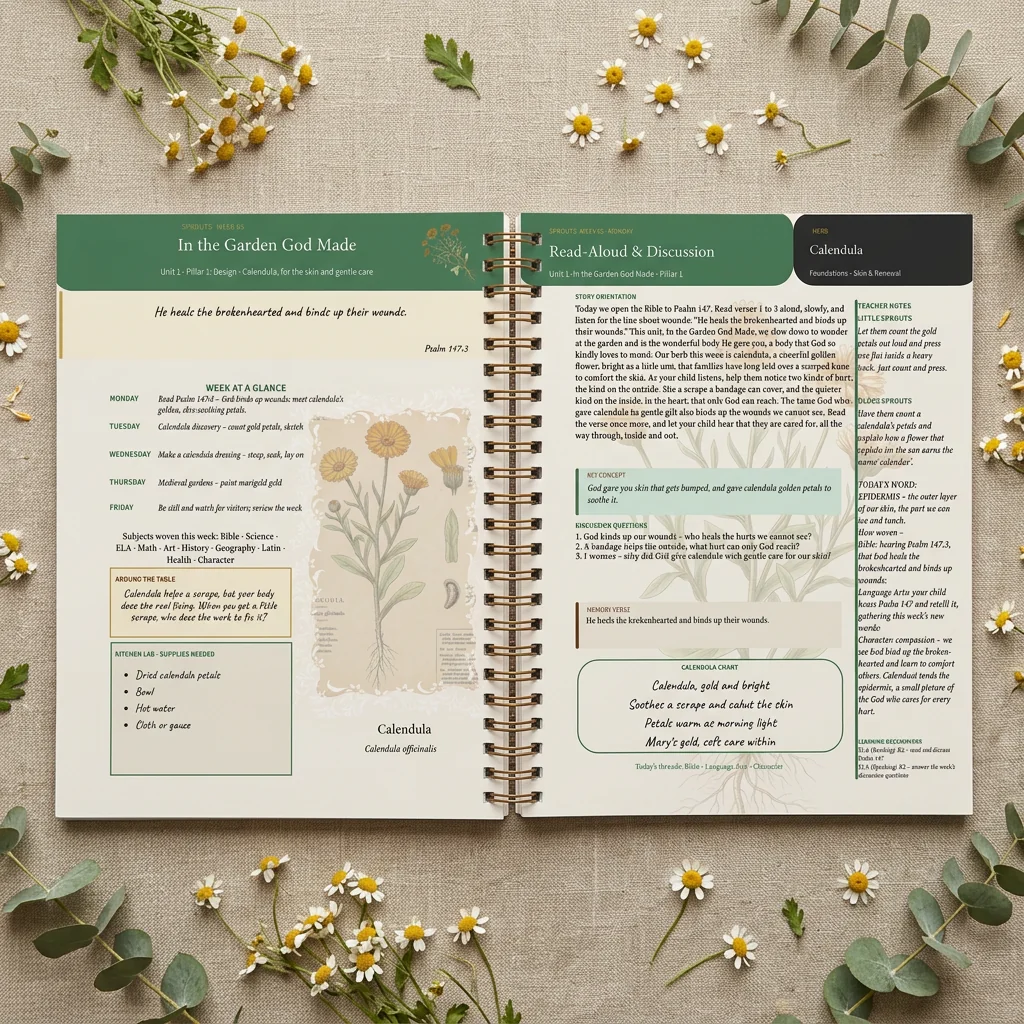
Teacher's Guide open to a week spread, with the Week at a Glance and the daily lesson pages

Inside the guide

Sprouts K-2 and Seedlings 3-5

Every lesson is written at two depths, so a younger and an older child work the same week at one table.

Open the guide on Monday morning and the week is already built. The read-aloud is scripted, the discussion questions are written, the memory verse is chosen, and the kitchen lab tells you exactly which supplies to set on the counter. Nothing is left for you to research the night before. What makes this guide unusual is how much it carries at once: a single week on a single plant quietly weaves Bible, science, language arts, math, art, history, geography, Latin, health, and character, and the Week at a Glance page tells you which day carries which. You are not stacking ten subjects into a day. You are teaching one plant well, and the disciplines come with it.

“It lies flat on the counter while your hands are busy, open to Wednesday, while the herb steeps.”

Component 3 · Student Notebook

The book your child fills in herself.

In the Starter Unit: weeks 1 to 9 of this, as a download.

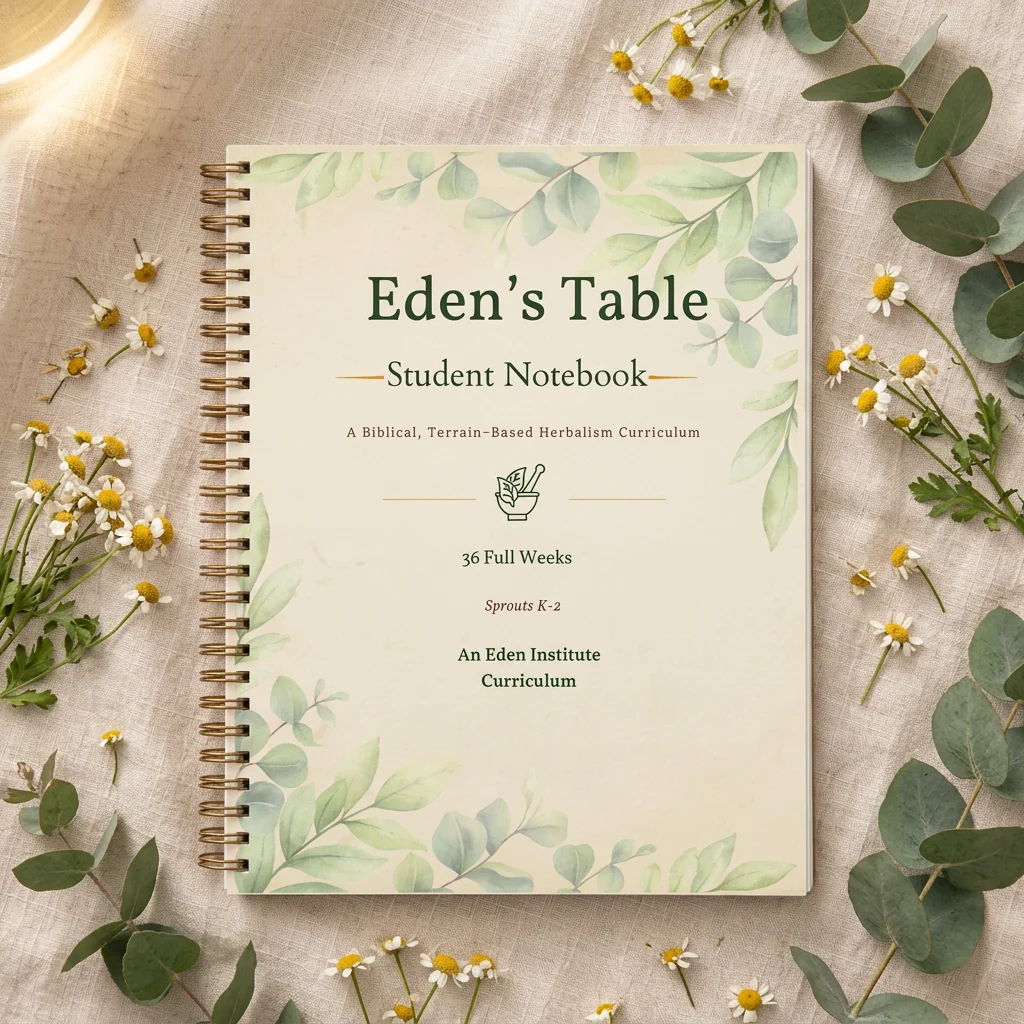
Eden's Table Student Notebook, coil-bound front cover
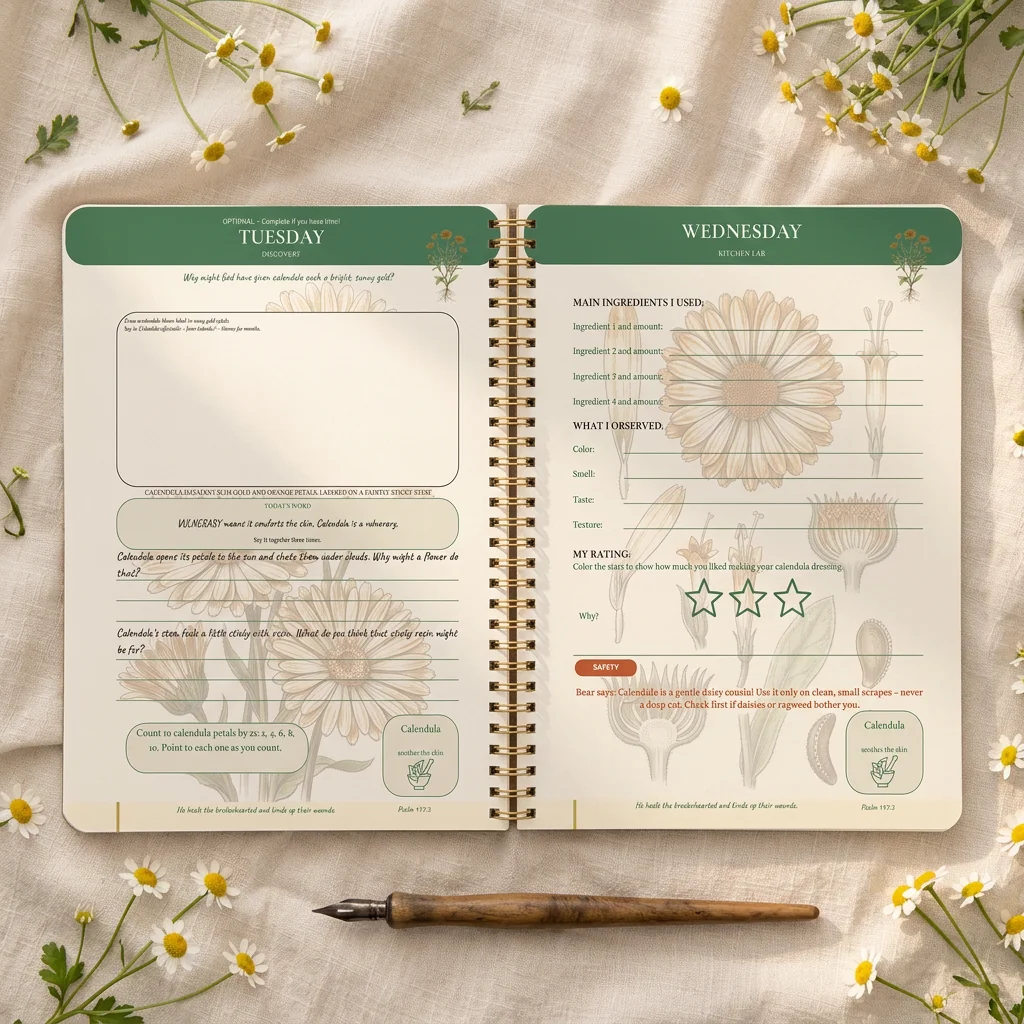
Student Notebook open to a week's pages, with observation fields and a drawing box

Inside the notebook

Sprouts K-2 and Seedlings 3-5

Color, smell, taste and texture at K-2 become measurements, ratios, and a hypothesis at 3-5.

It is a consumable workbook, but calling it that undersells what happens on the page. She draws the plant she just held. She records what it smelled like. She answers, in her own handwriting, a question that has no answer key, because some of the best questions in this curriculum genuinely do not have one. The enrichment work is deliberately marked optional, complete it if you have time, because a curriculum that punishes a hard week is a curriculum abandoned in February. This is also the practical answer to the record-keeping question: dated, sequential, in your child's own hand, showing observation, narration, scripture copywork, and real measurement across thirty-six weeks.

“It satisfies a reviewer. Far more importantly, it is the thing she carries to her grandfather and says look what I made.”

The ninth week

By week nine, it is not just tea.

The first labs are quick. Measure, pour, steep five minutes, taste. By Week 9 your child meets marshmallow root, and it does not work that way. Its softness will not come out in hot water, so the jar is filled with cool water in the morning and then left alone. Hours later they come back, strain the silky liquid through a sieve, stir in honey, and taste what waiting made. It is the first lab in the curriculum a child starts and has to return to, and it is a good part of why the unit runs to nine weeks rather than six.

Nine weeks, finished

This is not a preview of the curriculum. It is nine real weeks of it.

Forty-five daily lessons, written out the same way every other week of the year is written out. The same kitchen labs, the same memory work, the same dinner-table questions, the same stories. Nothing is thinned down because it is the trial. If you teach these nine weeks and stop, your child has still learned nine plants by sight and you have still had nine weeks of school you did not have to plan.

If your children are older

Starting with Sprouts when your children are older.

Parents of eight, ten and twelve year olds ask this constantly, and the honest answer surprises most of them. Start here anyway. Four reasons.

1. Skipping Sprouts costs you 36 plants, permanently.

Sprouts and Seedlings are not the same year at two reading levels. They teach different plants. Sprouts covers 36. Seedlings covers another 36. A family who works through both finishes with 72 named and usable species, which is a real apothecary. Begin at Seedlings and the first 36 are simply gone, because no later band circles back to collect them.

2. Sprouts is the first pass, not the shallow one.

Those 72 plants come back. In Cultivators, grades 6 to 8, your child meets them again through body pattern thinking and terrain. In Practitioners, grades 9 to 12, they meet them a third time at clinical depth. The plant a seven year old learns to recognize by smell is the same plant they reason about at sixteen. Missing the first pass does not save a year. It removes the floor the next two stand on.

3. The sensory work is the actual skill being taught.

Crush the leaf. Smell it. Taste it. Turn it over and feel the underside. That is not a warm-up for the real lesson, it is the lesson, and it is how a child learns to approach any living thing: look closely, use every sense, notice before you name. A child who skips it learns about plants. A child who does it learns to know them, and that habit of observation carries into every nature study they ever do. It is the one thing that genuinely does not transfer from a book, and it is the reason age matters less here than people expect.

4. One year, taught once, to every child at your table.

The reading level is K-2 so the youngest can join, and the plant work is real enough that the oldest is not bored by it. You teach one week, once, to everybody. An older child simply goes further within it: longer notebook entries, the botanical drawing done properly, the harder questions in the Teacher's Guide. They also move faster, so a year of Sprouts often takes an older child considerably less than a year.

You do not have to take our word for any of this. Nine weeks is $39, which is about four dollars a week, and your child will tell you the rest.

Questions

What happens right after I buy?

You will get an email within about a minute with three download links: the Teacher's Guide, the Student Notebook and the Read-Aloud storybook. The links stay live for seven days. Save the files to your own device and they are yours to keep. If the links lapse before you get to them, there is a link in that same email to send yourself fresh ones.

Can I print it?

Yes. Print as much of it as you like for your own household, as often as you like. The Student Notebook in particular is meant to be printed, because children write in it. The Teacher's Guide and the Student Notebook are letter size, so they come straight off an ordinary home printer. The storybook is a smaller 6 by 8 storybook page, which prints on letter paper with a margin around it.

Why nine weeks?

Because nine weeks is where the curriculum reaches a natural edge. Unit 1 finishes at week 6. Weeks 7 through 9 open Unit 2, so you see not just one unit but how the year moves between them. Four of the storybook's seven readings fall inside it, and the next one is not until week 18. Stopping at six would have handed you a finished unit and no idea what came after it.

What is in the download, exactly?

The Teacher's Guide, the Student Notebook and the Read-Aloud storybook for weeks 1 through 9, as PDFs you print at home. That is everything you need to teach those nine weeks, with no upgrade to buy to make them work. It is the 9-week starter. Weeks 10 through 36 are in the Printed Curriculum Set.

My children are older than K-2. Should I wait for Seedlings?

Almost always, no. Start with Sprouts. Skipping it does not move your child ahead, it removes 36 of the 72 plants they would otherwise finish with, and no later year goes back for them. The full reasoning is just above, under “Starting with Sprouts when your children are older”. Seedlings, for grades three through five, is in production and is not available as a starter unit yet.

Will an older child find it babyish?

This is the fear worth naming, so here is the honest answer. The reading level is K-2. The plant work is not. A nine year old identifying yarrow by the feel of the leaf underside is doing exactly what a fifteen year old does in Practitioners, with less vocabulary attached. What older children tend to resent is being talked down to, and the Teacher’s Guide never explains a plant twice. Take the nine weeks for $39 and let your child tell you, rather than guessing on their behalf.

Is it refundable?

Because it is a digital download, it is not refundable once the files have been downloaded. That is stated here rather than after you buy, so you can decide with it in front of you. If something is wrong with the files, email hello@edeninstitute.health and we will fix it.

Nine weeks, $39, in your inbox in a minute.

Already know you want the whole year? The Printed Curriculum Set is all 36 weeks in three printed books, $249 plus flat $12 shipping, printed to order and at your door in about two to three weeks.

See the printed year